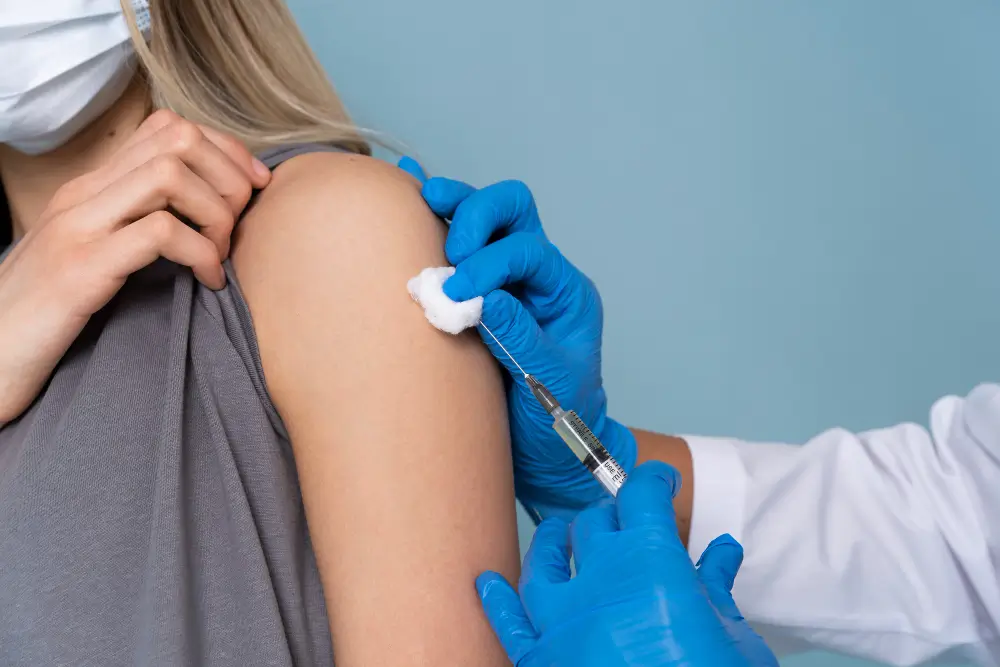
BPC-157 is a synthetic peptide derived from a protein found naturally in human gastric juice, used clinically to support gut-lining repair, tendon and joint recovery, and the regulation of inflammation. It works largely by promoting new blood vessel formation and activating the cells responsible for rebuilding connective tissue. At Patients Medical in New York, BPC-157 is prescribed only after evaluation and only through licensed compounding pharmacies.
Of all the peptides patients ask about, BPC-157 generates the most questions — and the most confusion. It is discussed constantly in athletic and biohacking circles, sold irresponsibly online, and genuinely useful when prescribed properly. This guide separates the three.
What BPC-157 actually is
BPC stands for “Body Protection Compound.” The peptide is a synthesized fragment of a larger protective protein that occurs naturally in the human digestive tract, where its biological job appears to be maintaining and repairing the integrity of the gut lining in a chemically hostile environment. Researchers isolated the active sequence — fifteen amino acids — and found that this fragment retained protective and reparative activity well beyond the stomach.
That origin explains two of BPC-157’s most notable properties. First, it is unusually stable in gastric acid compared with most peptides, which is why oral formulations are viable for gut-focused goals when many other peptides must be injected. Second, its native role is tissue protection, not stimulation of growth or hormone release — a mechanistic distinction that matters when patients ask how it compares with growth hormone peptides.
How BPC-157 works
Three mechanisms account for most of what BPC-157 is used for clinically.
- Angiogenesis: Injured tissue is frequently oxygen- and nutrient-starved because its blood supply is compromised — a core reason tendons, ligaments, and gut lining heal slowly. BPC-157 promotes the formation of new capillaries in injured areas, restoring the delivery route healing cells depend on. This is thought to be its single most important action.
- Fibroblast activation and migration: Fibroblasts produce collagen and the structural proteins that give tissue its integrity. BPC-157 both activates these cells and enhances their migration toward injury sites, meaning repair crews arrive faster and work harder.
- Growth factor and nitric oxide signaling: BPC-157 interacts with growth-factor pathways and the nitric oxide system, which contributes to its effects on blood flow, tissue remodeling, and inflammatory regulation.
Importantly, BPC-157 appears to modulate inflammation rather than simply suppress it. Inflammation is a necessary phase of healing; the problem in chronic conditions is that it fails to resolve. This distinction is why the peptide is used in inflammatory gut conditions rather than being avoided in them.
BPC-157 and gut health
The gut is where BPC-157 has the strongest mechanistic rationale, and where our patients most often see it prescribed.
Intestinal permeability (“leaky gut”)
The intestinal lining is a single cell layer thick, sealed by tight junction proteins. When those junctions loosen — from chronic stress, medications including NSAIDs, infections, alcohol, food reactivity, or dysbiosis — partially digested particles and bacterial products cross into circulation and provoke systemic immune activation. Patients experience this as bloating, food sensitivities, fatigue, brain fog, joint aches, and skin changes that never trace back to a single cause.
BPC-157 supports the structural repair of this barrier. In integrative practice it is typically layered onto foundational work — removing triggers, addressing dysbiosis, and rebuilding nutritional status — rather than substituting for it. Patients who have done that foundational work but plateaued are often the best candidates.
Gastric and inflammatory conditions
Given its gastric origin, BPC-157 has been studied for protection of the stomach lining, including against NSAID-related injury, and as supportive care in inflammatory bowel conditions. This is supportive care, not disease treatment: it does not replace gastroenterology management of Crohn’s disease or ulcerative colitis, and Dr. Gulati coordinates with treating specialists rather than around them.
The gut-everything connection
Because the gut houses most of the immune system and much of the body’s neurotransmitter production, patients who improve gut-barrier integrity frequently report changes far from the abdomen — steadier mood, clearer thinking, calmer skin, less joint discomfort. This is also why BPC-157 appears in protocols aimed at thyroid support, since gut health influences the peripheral conversion of T4 to active T3.
BPC-157 for tendons, joints, and injury recovery
The second major use is musculoskeletal. Tendons and ligaments are notoriously slow healers precisely because they are poorly vascularized — the exact deficit BPC-157’s angiogenic activity addresses.
Patients most commonly ask about it for chronic tendinopathy (Achilles, patellar, elbow, rotator cuff), ligament sprains, muscle strains, post-surgical recovery, and stubborn overuse injuries in active adults who do not want to stop training. Animal research has been consistently favorable across tendon, ligament, muscle, and bone healing models; human clinical trial data remain limited, and any honest discussion says so. What we can say is that the mechanism is coherent, the safety profile in supervised use has been reassuring, and many patients report meaningful functional improvement.
BPC-157 is frequently paired with TB-500 (Thymosin Beta-4), which promotes cell migration and tissue flexibility through a complementary mechanism. The combination is common in recovery protocols; whether it is appropriate for you depends on your injury, history, and goals.
Oral versus injectable BPC-157
This is the most practical question patients have, and the answer is goal-dependent.
- Oral capsules exploit BPC-157’s acid stability and deliver high local concentration to the digestive tract. This makes oral the frequent choice for gut-focused goals — intestinal permeability, gastritis, inflammatory bowel support.
- Subcutaneous injection delivers the peptide systemically and is generally preferred for musculoskeletal targets, where the peptide often is administered near — though not into — the injured area. The needles are insulin-style and very fine; patients are taught administration in the office and nearly all find it far easier than anticipated.
Some protocols use both. Dosing, frequency, and cycle length are individualized and are not appropriate to publish as general guidance — dosing that suits a 55-year-old with Hashimoto’s and gastritis is not dosing for a 32-year-old with a torn hamstring.
Who is a good candidate for BPC-157
In my experience the patients who benefit most fall into four groups.
- The patient with a stalled gut: She has already removed the obvious triggers, treated a dysbiosis, cleaned up her diet, and improved — but not resolved. Bloating persists, foods she used to tolerate still cause trouble, and progress has plateaued for months. BPC-157 is at its most useful in exactly this situation: as the repair layer on top of work already done.
- The active adult with a chronic tendon problem: Six months of an aching Achilles or an elbow that flares with every return to training. Physical therapy has helped and stopped helping. Rest resolves it until activity resumes. These injuries persist precisely because the tissue’s blood supply cannot support the repair required, which is the deficit BPC-157 addresses.
- The post-surgical patient: Someone recovering from an orthopedic procedure who wants to support healing during the window when it matters most. Timing and coordination with the surgeon are essential here, and I ask patients to disclose peptide use to their surgical team.
- The patient on necessary but irritating medication: Long-term NSAID use, for example, where gastric protection is a legitimate goal.
Conversely, BPC-157 is often not the right starting point for a patient with undiagnosed digestive symptoms, active infection, or an untreated systemic condition. A patient with unexplained abdominal pain, weight loss, or bleeding needs a diagnosis before anything else — and I have seen peptide use delay diagnoses that mattered.
How protocols are structured
Patients frequently want to know what a protocol looks like in practice, even understanding that specifics are individualized.
Most BPC-157 courses are time-limited rather than open-ended. The peptide is used as a repair intervention during a defined healing window — commonly measured in weeks to a few months — rather than taken indefinitely. This is a meaningful difference from the hormone and longevity peptides, where longer-term maintenance is more common.
Route follows target, as described above. Frequency and timing are set by the compound’s characteristics and your goals. Where a musculoskeletal injury is the target, administration is often directed near the affected region while remaining subcutaneous — not injected into the joint or tendon itself, which is a procedure requiring different training and imaging.
Progress is assessed both subjectively and objectively where possible: symptom scores, functional benchmarks such as range of motion or training tolerance, and repeat laboratory markers where inflammation or gut function was measurable at baseline. If a course produces no meaningful change, the correct response is to reassess the diagnosis — not to extend the protocol indefinitely or add compounds.
Safety, evidence, and the honest limitations
Three things patients deserve to hear plainly.
- The human evidence base is thinner than the internet suggests: Most BPC-157 research is preclinical. Preclinical results have been remarkably consistent and the peptide has shown a favorable toxicity profile, but “promising in animal models with good clinical experience” is a different claim from “proven in randomized human trials,” and we do not blur the two.
- Regulatory status is nuanced and changing: BPC-157 is not an FDA-approved drug. It has at times been prescribed as a compounded preparation, and compounding rules in this category have shifted recently. Dr. Gulati will explain the current status of anything she recommends, and will tell you when a compound is not currently available through legitimate channels. Read our full explainer: Are peptides safe? FDA rules and choosing a doctor.
- Online BPC-157 is a genuine hazard: Products labeled “research use only” are not manufactured to human pharmaceutical standards. Independent testing of gray-market peptides has repeatedly found underdosing, overdosing, degradation, and contamination. Patients also self-select doses with no lab monitoring, no interaction screening, and no one watching for adverse effects.
Reported side effects in supervised use are typically mild: injection-site irritation, occasional transient nausea or headache. BPC-157 is generally avoided or requires careful case-by-case evaluation in patients with active malignancy, given its angiogenic action, and during pregnancy and breastfeeding.
How BPC-157 therapy works at Patients Medical
Your care begins with a one-hour evaluation with Dr. Rashmi Gulati, MD ($600), covering your history, symptoms, prior treatment, and goals. Depending on your presentation, laboratory work through Labcorp or Quest may include inflammatory markers, comprehensive stool analysis, nutritional status, and metabolic panels — because a gut complaint frequently has a driver that BPC-157 alone will not fix.
If BPC-157 is appropriate, you receive a protocol specifying compound, route, dose, and duration, prescribed through a licensed U.S. compounding pharmacy. Peptide costs are additional to the consultation and vary with the type and amount prescribed; you receive exact pricing before beginning. Follow-up visits track response and adjust the protocol, with fees depending on visit length and the treatment provided. BPC-157 is frequently one component of a broader plan that may include immune peptide support, nutritional therapy, or hormone care.
Frequently asked questions
Q. Is BPC-157 legal?
A. BPC-157 is not an FDA-approved drug. Its availability through compounding pharmacies has been subject to changing regulatory interpretation. A physician-supervised program uses only legally available pathways and will tell you when a compound is not currently obtainable through them.
Q. How long before BPC-157 works?
A. Gut-focused patients often report changes within two to six weeks. Musculoskeletal recovery typically follows the tissue’s own timeline — weeks to a few months — and BPC-157 is used to support that process, not to override it.
Q. Can I take BPC-157 with my medications?
A. This must be evaluated individually. Bring a complete medication and supplement list to your consultation.
Q. Is BPC-157 a steroid or a growth hormone?
A. No. It is neither anabolic in the steroid sense nor a growth hormone secretagogue. For growth hormone peptides, see CJC-1295 and Ipamorelin.
Q. Can I buy BPC-157 online instead?
A. We strongly advise against it, for the reasons above.
Ready to find out whether BPC-157 fits your situation?
Learn more about peptide therapy in NYC at Patients Medical, 1148 Fifth Avenue, Suite 1B, New York, NY 10128. Call (212) 794-8800 or start with a free 10-minute introductory call.
Medical disclaimer: educational content only; not a substitute for professional medical advice, diagnosis, or treatment. Individual results vary. Certain peptides are prescribed off-label or as compounded preparations.

Dr. Kulsoom Baloch
Dr. Kulsoom Baloch is a dedicated donor coordinator at Egg Donors, leveraging her extensive background in medicine and public health. She holds an MBBS from Ziauddin University, Pakistan, and an MPH from Hofstra University, New York. With three years of clinical experience at prominent hospitals in Karachi, Pakistan, Dr. Baloch has honed her skills in patient care and medical research.
- Dr. Kulsoom Baloch

- Dr. Kulsoom Baloch

- Dr. Kulsoom Baloch

- Dr. Kulsoom Baloch