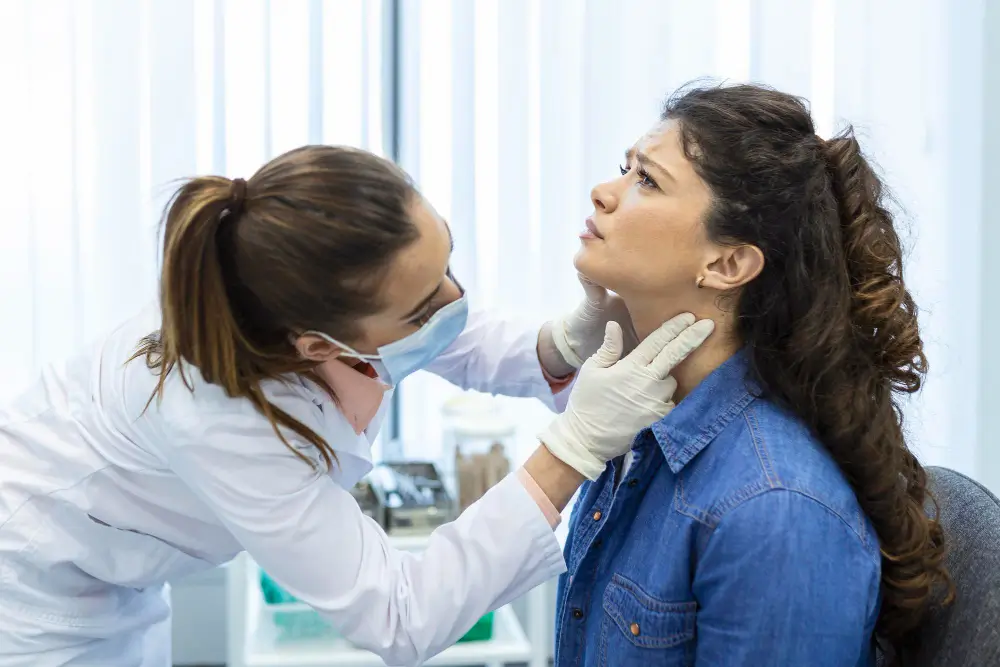
Peptides can support thyroid health indirectly — by modulating the autoimmune activity that drives Hashimoto’s, improving the gut environment where much T4-to-T3 conversion occurs, calming inflammation that impairs cellular thyroid hormone response, and addressing the fatigue that persists in treated patients. Peptides do not replace thyroid hormone medication when it is needed, and no responsible physician would suggest otherwise.
I want to state that limitation at the outset because thyroid patients have been failed enough times by people promising alternatives to treatment they genuinely require. What follows is how I actually use peptides in thyroid care in my Manhattan practice — as a complementary layer within conventional and integrative thyroid management, not as a substitute for it.
The patient this article is written for
She is treated. Her TSH is in range. Her endocrinologist tells her, accurately, that her labs look fine. And she is still exhausted, still gaining weight, still losing hair, still cold, still foggy. When she says so, she is told her thyroid is not the problem anymore.
Sometimes that is true and something else is going on. Often, though, a normalized TSH has simply not translated into normalized thyroid function at the cellular level — and that gap is where peptide therapy has a legitimate role.
The thyroid axis in plain language
Your hypothalamus releases TRH, which tells the pituitary to release TSH, which tells the thyroid gland to produce hormone — mostly T4, which is largely inactive, plus a smaller amount of active T3. Most active T3 is produced elsewhere: T4 is converted to T3 by deiodinase enzymes in the liver, kidneys, gut, and other peripheral tissues. T3 then must enter cells and bind nuclear receptors to do anything at all.
Standard testing measures TSH, which is a pituitary signal, not a measure of what your cells are receiving. A patient can have a perfect TSH and still have poor peripheral conversion, elevated reverse T3, or impaired cellular response. Four downstream failure points — conversion, transport, receptor sensitivity, and autoimmune destruction of gland tissue — are all invisible on a TSH-only panel, and three of the four are places peptides can help.
Where peptides fit in thyroid care
Autoimmune modulation in Hashimoto’s
Hashimoto’s thyroiditis, the leading cause of hypothyroidism in the United States, is fundamentally an autoimmune condition: the immune system attacks thyroid tissue. Standard treatment replaces the hormone the damaged gland can no longer make, but does nothing about the immune process doing the damage.
Thymosin Alpha-1 is an immune-modulating peptide that supports appropriate T-cell regulation. In autoimmune conditions the goal is not immune stimulation — that would be counterproductive — but modulation toward balance. I use it in selected Hashimoto’s patients, particularly those with high antibody titers and coexisting chronic infection or immune dysregulation. Antibody titers are tracked over time as one objective marker. Read more in our guide to Thymosin Alpha-1 and immune peptides.
The gut-thyroid connection
A meaningful proportion of T4-to-T3 conversion depends on a healthy gut environment and microbiome. Intestinal permeability is also strongly associated with autoimmune activation generally, and Hashimoto’s specifically — which is why so many of my thyroid patients also have digestive complaints, and why treating the gut sometimes moves thyroid markers.
BPC-157 supports intestinal lining repair, and KPV helps calm gut inflammation. In a Hashimoto’s patient with bloating, food reactivity, and elevated antibodies, addressing the gut is not a detour from thyroid care — it is thyroid care. See BPC-157 for gut healing
The fatigue that persists after treatment
This is the most common reason my thyroid patients end up on peptides. Even with optimized thyroid hormone levels, mitochondrial function can remain impaired after a prolonged hypothyroid period — the cellular machinery does not immediately recover just because the signal returned.
MOTS-c, a mitochondrially derived peptide, supports cellular energy production and metabolic efficiency. NAD+ supports the same machinery from a different angle. In practice these are what I reach for when a patient’s thyroid labs are genuinely optimized and she still cannot get through the afternoon. This overlaps substantially with adrenal and stress-axis work; see peptides for adrenal function and stress resilience.
Sleep, stress, and the axis above the thyroid
Chronic stress suppresses TSH output and impairs T4-to-T3 conversion while raising reverse T3, the inactive competitor. Poor sleep does the same. DSIP and Selank support sleep quality and stress resilience respectively, and in patients whose thyroid problem is substantially driven by an overloaded stress axis, this is often more productive than another medication adjustment.
Testing first, always
I do not prescribe a peptide for a thyroid patient before seeing a complete picture. My standard panel:
- TSH — the pituitary signal, useful but insufficient alone
- Free T4 and free T3 — what is actually circulating and available
- Reverse T3 — the inactive form that competes at the receptor; frequently elevated in stress, inflammation, and illness
- TPO and thyroglobulin antibodies — to identify autoimmune activity and track it over time
- Cortisol rhythm (four-point salivary or DUTCH) and DHEA-S — because the adrenal and thyroid axes are inseparable
- Comprehensive metabolic panel, ferritin, vitamin D, B12, and selenium — deficiencies here impair conversion and are commonly missed
- Inflammatory markers — hs-CRP and others as indicated
What that panel shows determines everything. A patient with high antibodies and gut symptoms gets a different protocol from a patient with normal antibodies, high reverse T3, and a flattened cortisol curve. This is why I cannot offer a “thyroid peptide protocol” as a product — the protocol is the output of the workup, not the input.
What this looks like in practice
Three composite pictures, drawn from patterns I see regularly. Details are altered and these are illustrative rather than individual case reports.
- The treated Hashimoto’s patient who still feels unwell: She is on thyroid hormone replacement, her TSH is in range, and she is exhausted with persistent bloating and food reactivity. Testing shows high TPO antibodies, low-normal free T3 with elevated reverse T3, low ferritin, and a flattened cortisol curve. The plan addresses several things at once: iron repletion, gut repair with BPC-157, immune modulation with Thymosin Alpha-1, and sleep and stress support — with her prescribing physician handling any medication adjustment. Antibodies, ferritin, and the full thyroid panel are rechecked at defined intervals.
- The patient whose thyroid is not actually the problem: He was told his thyroid was borderline and has been chasing it for two years. His full panel is genuinely unremarkable; his cortisol rhythm is inverted, his ferritin is low, and screening suggests untreated sleep apnea. He needs a sleep study and iron, not peptides. Finding this is a good outcome, and I would rather deliver that answer than a protocol.
- The patient with poor conversion: Her TSH and free T4 look fine; her free T3 sits at the bottom of the range and her reverse T3 is high. She is chronically stressed, undereating, and over-exercising. Peptides supporting sleep and stress resilience help, but the primary intervention is reducing the physiological load driving the conversion problem, alongside correcting the nutrient cofactors — selenium, zinc, iron — that conversion depends on.
The common thread is that the peptide is never the first decision. The workup determines the problem; the protocol follows from it.
Sequencing thyroid care
The order I follow with thyroid patients rarely varies.
- First, establish the diagnosis properly: Full panel including antibodies, not TSH alone. A patient with high antibodies and normal TSH has Hashimoto’s in an early stage and should be monitored and supported, not dismissed.
- Second, get the hormone replacement right: Where medication is indicated, dose and formulation come first, managed by the prescribing physician. Peptides layered onto inadequate replacement will disappoint.
- Third, correct the cofactors: Iron, vitamin D, selenium, zinc, and B12 are required for thyroid hormone production, conversion, and receptor function. Deficiencies here are common, cheap to fix, and frequently account for a meaningful share of residual symptoms.
- Fourth, address the axes above and beside the thyroid: Cortisol rhythm and sex hormones both influence thyroid function directly, and in midlife women the three are rarely separable.
- Fifth, layer peptides for what remains: Autoimmune activity, gut integrity, mitochondrial recovery, sleep, and stress resilience.
- Sixth, measure: Repeat panels and antibody titers at defined intervals, with the protocol adjusted on data rather than impression.
What I tell patients honestly
- Peptides do not restore destroyed thyroid tissue: If your gland has been substantially damaged by autoimmune disease, you will need thyroid hormone replacement, likely for life. Peptides may help slow ongoing damage and improve how you feel on treatment. They will not regrow the gland.
- Peptides are not a substitute for optimized thyroid medication: If your free T3 is at the bottom of the range, the answer is to address your thyroid medication — with your prescribing physician — not to layer peptides on top of an inadequate foundation.
- The evidence here is mechanistic and clinical, not randomized-trial-based: There are no large controlled trials of peptides in thyroid disease. What exists is a coherent physiological rationale, a reasonable safety profile under supervision, and clinical experience. I present that as what it is.
- Some patients do not need peptides at all: Frequently the fix is iron, vitamin D, sleep, or a medication adjustment. I would rather find that than sell a protocol.
Coordinated care at Patients Medical
Thyroid patients at our Fifth Avenue office begin with a one-hour evaluation with me ($600), covering symptom history, treatment history, prior labs, and goals, followed by comprehensive testing through Labcorp or Quest. Where thyroid hormone replacement is indicated or needs adjustment, that comes first. Where hormone deficiency extends beyond the thyroid — common in perimenopausal and menopausal women — bioidentical hormone replacement therapy (BH.nyc) may be part of the plan. Peptides are then layered where they add something specific.
Peptide costs are additional to the consultation and vary with the type and amount prescribed. Follow-up visits recheck thyroid panels, antibodies, and symptom response; fees depend on visit length and the treatment provided. I coordinate with your endocrinologist or primary physician rather than around them.
Frequently asked questions
Q. Can peptides cure Hashimoto’s?
A. No. Peptides may support immune modulation and help reduce ongoing autoimmune activity, but Hashimoto’s is not currently curable and I do not present peptides as a cure.
Q. Can I stop my thyroid medication if I start peptides?
A. No. Never adjust or discontinue thyroid medication without your prescribing physician. Peptides work alongside thyroid hormone, not instead of it.
Q. Which peptide is best for hypothyroidism?
A. There is no single answer, because hypothyroid patients differ enormously in their limiting factor. The right peptide follows from the workup.
Q. Will peptides help me lose the weight I gained from my thyroid?
A. Possibly, as part of a broader plan. Thyroid-related weight gain has multiple drivers. See peptide injections for weight loss and metabolic health.
Q. Are peptides safe for thyroid patients?
A. Under physician supervision with appropriate monitoring, generally yes, with individual contraindications. See Are peptides safe? FDA rules and choosing a doctor.
Q. Still exhausted despite normal thyroid labs?
A. Learn about peptide therapy in NYC at Patients Medical, 1148 Fifth Avenue, Suite 1B, New York, NY 10128. Call (212) 794-8800 or start with a free 10-minute introductory call.
Medical disclaimer: educational content only; not a substitute for professional medical advice, diagnosis, or treatment. Never adjust thyroid medication without your prescribing physician. Individual results vary; certain peptides are prescribed off-label or as compounded preparations.

Dr. Kulsoom Baloch
Dr. Kulsoom Baloch is a dedicated donor coordinator at Egg Donors, leveraging her extensive background in medicine and public health. She holds an MBBS from Ziauddin University, Pakistan, and an MPH from Hofstra University, New York. With three years of clinical experience at prominent hospitals in Karachi, Pakistan, Dr. Baloch has honed her skills in patient care and medical research.
- Dr. Kulsoom Baloch

- Dr. Kulsoom Baloch

- Dr. Kulsoom Baloch

- Dr. Kulsoom Baloch