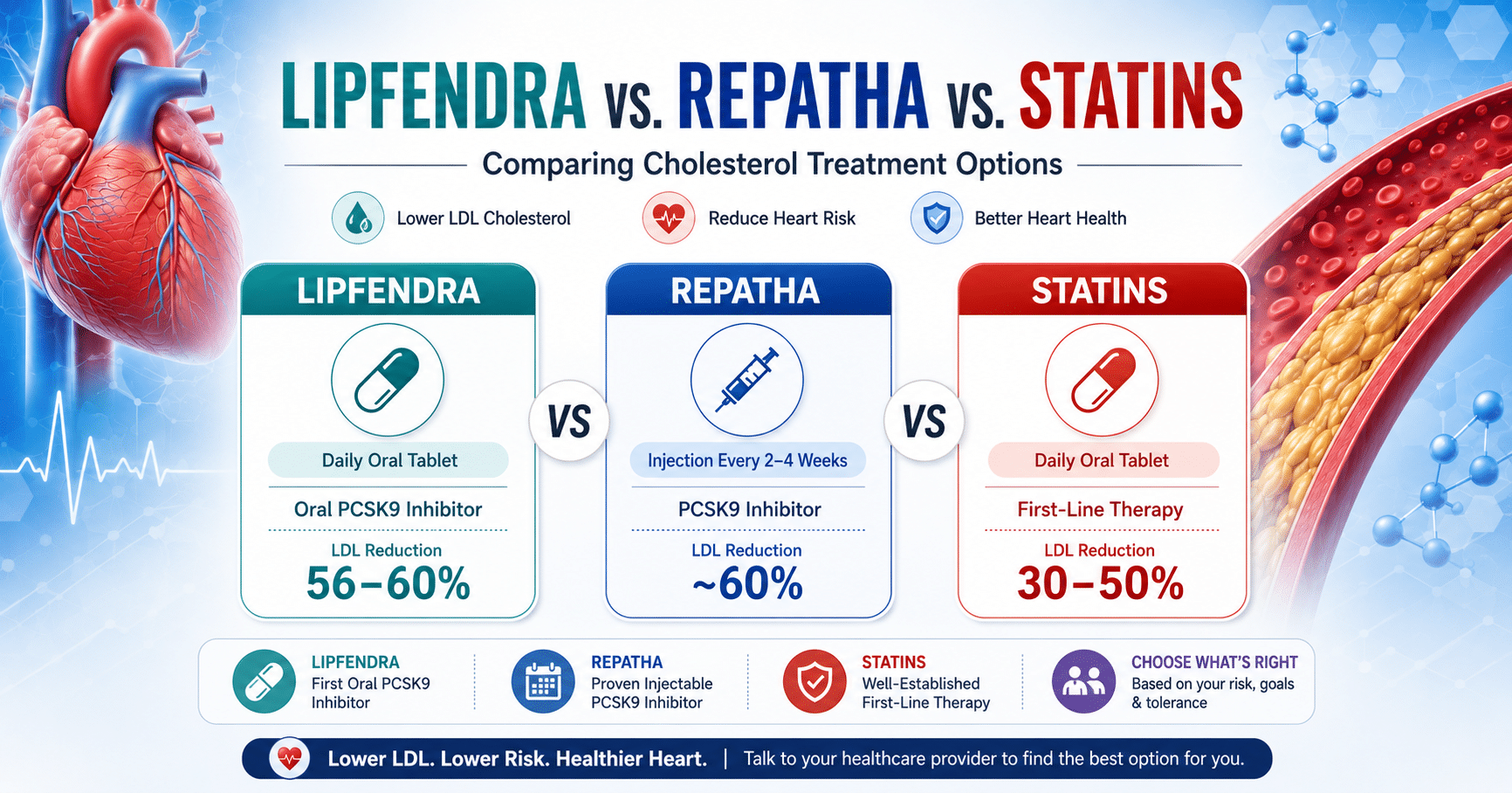
Lipfendra, Repatha, and statins all help lower LDL cholesterol, often called “bad” cholesterol. However, they work in different ways and are usually prescribed at different stages of treatment.
Statins are generally the first medication doctors recommend for high cholesterol. They can lower LDL by around 30% to 50%, depending on the type and dose.
Repatha is an injectable PCSK9 inhibitor. It is often considered when statins are not lowering cholesterol enough and can reduce LDL by about 60%.
Lipfendra, approved in July 2026, is the first oral PCSK9 inhibitor. It offers a similar LDL reduction of around 56% to 60%. Still, it is taken as a daily pill rather than an injection.
Here is how the three treatments compare and what may influence your doctor’s recommendation.
Quick Comparison
| Feature | Statins | Repatha | Lipfendra |
| Form | Daily oral pill | Injection every 2 to 4 weeks | Daily oral pill |
| Typical LDL reduction | 30% to 50% | Around 60% | 56% to 60% |
| When it is used | Usually first-line treatment | Added when statins are not enough | Added when statins are not enough |
| How it works | Reduces cholesterol production in the liver | Blocks the PCSK9 protein | Blocks the PCSK9 protein |
| Commonly prescribed for | High cholesterol | High cholesterol or HeFH not controlled with statins | High cholesterol or HeFH not controlled with statins |
| Estimated monthly cost | Often under $50 for generic options | Depends on insurance |
Around $315 |
| Proven to reduce heart attacks and strokes? | Yes | Yes | Not yet confirmed in dedicated outcome trials
|
What Is Lipfendra?
Lipfendra, also known as enlicitide, is a cholesterol-lowering medication approved by the FDA on July 16, 2026.
It is the first PCSK9 inhibitor available as a once-daily tablet. It works in a similar way to injectable drugs such as Repatha but does not require a shot.
In clinical trials, Lipfendra lowered LDL cholesterol by approximately 56% to 60% when added to statin therapy.
What Is Repatha?
Repatha, or evolocumab, is an injectable PCSK9 inhibitor.
It is commonly prescribed for people whose LDL cholesterol remains high despite taking statins. It may also be used for people with familial hypercholesterolemia, an inherited condition that causes unusually high cholesterol levels.
Repatha is injected under the skin, usually once every two or four weeks, and can lower LDL cholesterol by about 60%.
What Are Statins?
Statins are the most commonly prescribed first-line medications for high cholesterol.
Examples include atorvastatin, rosuvastatin, and simvastatin. These medications work by blocking an enzyme the liver uses to produce cholesterol.
Depending on the medication and dose, statins can lower LDL by roughly 30% to 50%.
They have also been studied for decades and have strong evidence showing that they can reduce the risk of heart attacks and strokes.
Lipfendra vs. Repatha: What Is the Main Difference?
Lipfendra and Repatha work similarly. Both block PCSK9, a protein that reduces the liver’s ability to remove LDL cholesterol from the bloodstream.
They also lower LDL by a similar amount.
The biggest difference is how they are taken.
Repatha is given as an injection every two to four weeks, while Lipfendra is taken as a daily pill.
For some patients, this difference may be important. Many people who qualify for PCSK9 treatment never begin it because they are uncomfortable with injections, concerned about cost, or face difficulties getting insurance approval.
An oral option may make PCSK9 treatment easier for people who have avoided injectable medications.
Lipfendra vs. Statins: Do You Need Both?
In most cases, yes.
Lipfendra is not intended to replace statins. It is usually added to statin therapy when LDL cholesterol remains above the recommended level.
In the Phase 3 Lipfendra trial, participants were already taking statins. Adding Lipfendra lowered LDL by another 56% to 60% beyond the reduction already achieved with statin treatment.
For most people, statins remain the starting point.
Lipfendra or Repatha may be considered when statins alone are not enough, even at a higher dose. They may also be recommended for people with heterozygous familial hypercholesterolemia, commonly known as HeFH.
Does Lipfendra Prevent Heart Attacks and Strokes?
That has not yet been confirmed through completed long-term outcome trials.
Lipfendra was approved based on its ability to lower LDL cholesterol. Studies directly measuring whether it reduces heart attacks, strokes, and cardiovascular deaths are still ongoing.
Statins and Repatha already have established evidence showing that they reduce cardiovascular events.
Lower LDL is strongly linked with a lower risk of heart disease. However, Lipfendra’s own long-term outcome data are still being collected.
Which Treatment May Be Right for You?
The right treatment depends on your LDL level, overall heart risk, medical history, and how well you respond to your current medication.
You have not tried a statin.
A statin is usually the first treatment your doctor will recommend.
Your LDL is still high while taking a statin.
Lipifendro or Repatha may be considered as an additional treatment.
The choice may depend partly on whether you prefer a daily pill or an injection every few weeks.
You have familial hypercholesterolemia.
People with HeFH may need a PCSK9 inhibitor in addition to statin therapy because their cholesterol is largely driven by genetics.
You avoided PCSK9 treatment because of injections.
Lipfendra may provide an alternative for people who are uncomfortable with injectable medications.
Your doctor will consider your cholesterol numbers, cardiovascular risk, other health conditions, and current medications before recommending a treatment plan.
Frequently Asked Questions –
Q. Is Lipfendra as effective as Repatha?
A. Both medications lower LDL by a similar amount, usually around 56% to 60%.
They also work through the same PCSK9-blocking pathway. The main difference is that Lipfendra is taken as a daily pill, while Repatha is given by injection.
Q. Can I take Lipfendra instead of a statin?
A. Lipfendra is generally used alongside statin therapy rather than as a replacement. It is intended for people whose LDL cholesterol remains high despite taking a statin.
Q. How much does Lipfendra cost?
A. Lipfendra has been priced at approximately $315 per month. Because it is a newly approved medication, insurance coverage and out-of-pocket costs may vary between plans.
Q. What are the possible side effects of Lipfendra?
A. The most commonly reported side effects in clinical trials were diarrhea and dizziness.
Q. Looking Beyond Cholesterol Medication
A. Statins, Repatha, and Lipfendra can all help lower the cholesterol number shown on a lipid panel. However, cholesterol levels may be influenced by several underlying factors, including genetics, thyroid problems, insulin resistance, inflammation, diet, lifestyle, and elevated lipoprotein(a), or Lp(a).
These factors may not always be fully identified through a basic cholesterol test.
At Patients Medical, a functional and integrative medicine practice in New York City, our physicians take a broader look at what may be contributing to high cholesterol.
Depending on the patient, this may include more detailed testing, nutrition guidance, lifestyle changes, and targeted support alongside any medication prescribed by the patient’s treating doctor.
This may include statins, Repatha, Lipfendra, or another cholesterol treatment when appropriate.
Lowering LDL is important, but understanding what is contributing to high cholesterol can help create a more complete and personalized long-term plan.
Patients who want to understand better their cholesterol levels can speak with our team for a more detailed evaluation.

Rashmi Gulati
Rashmi Gulati, MD, provides innovative, individualized health care that nurtures mind, body, and spirit. Since 2004 she has been the medical director at Patients Medical, where she delivers comprehensive personalized health care, treating each patient as a respected, unique individual. Through their integrative health care center in the heart of Manhattan, Dr. Gulati and her colleagues have become premier care providers serving patients locally and throughout the world. Read more about the author →
- Rashmi Gulati

- Rashmi Gulati

- Rashmi Gulati

- Rashmi Gulati