Medically reviewed by Dr. Rashmi Gulati, MD, Medical Director of Patients Medical
Last updated: July 20, 2026
For years, one of the most powerful types of cholesterol-lowering medication faced a surprisingly simple problem: many patients did not want an injection.
PCSK9 inhibitors can reduce LDL, often called “bad” cholesterol, by around 60%. That is far more than many people achieve with statins alone. Even so, only a small percentage of eligible patients have used them.
The issue was not necessarily how well the medications worked. For many people, the main barrier was the needle.
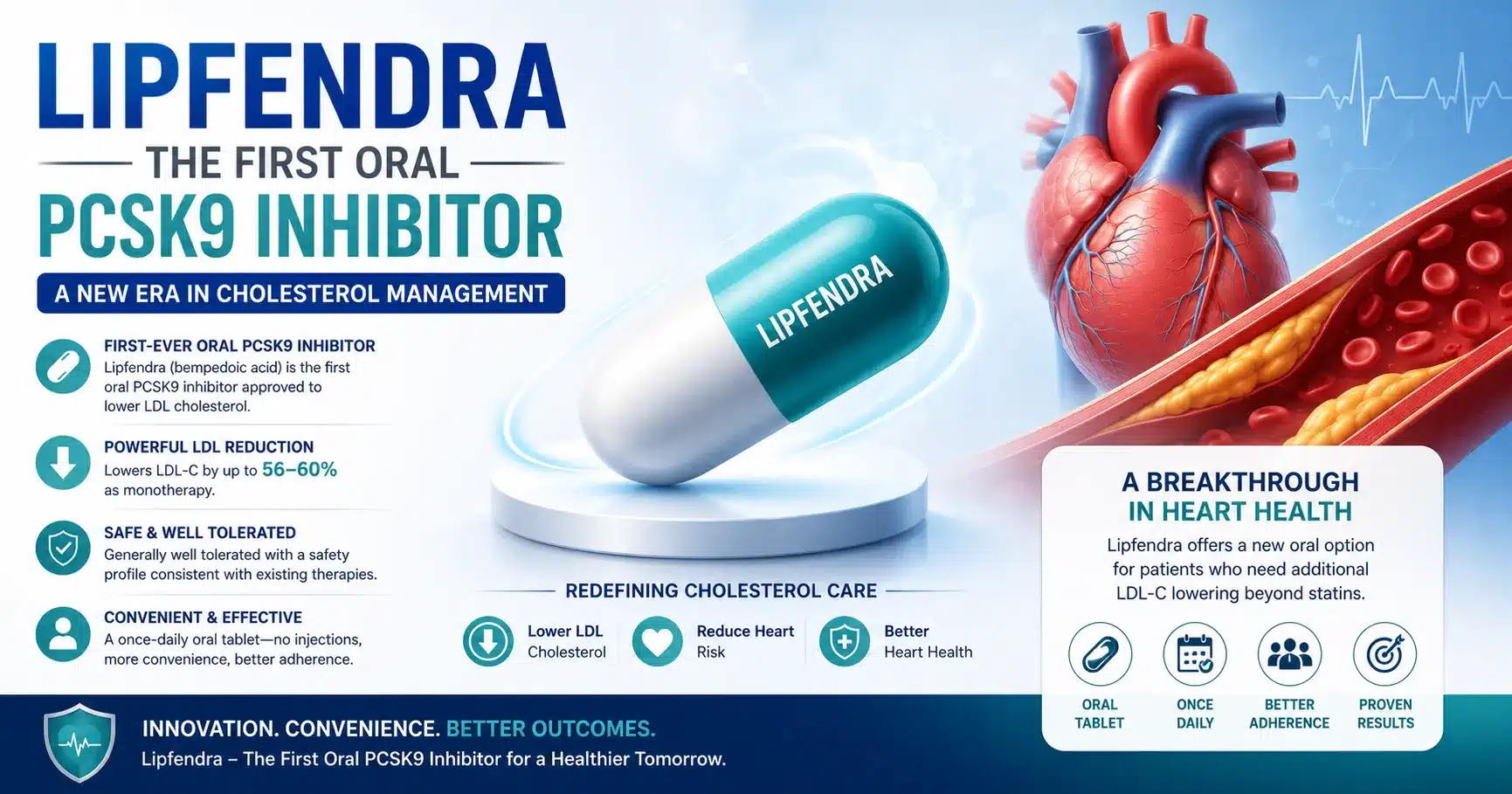
On July 16, 2026, the FDA approved Lipfendra, also known as enlicitide, developed by Merck. It became the first PCSK9 inhibitor available as a once-daily tablet.
Its approval marks an important step in cholesterol treatment. It also raises an interesting question: how did scientists turn out a type of drug that normally has to be injected into something that can be swallowed?
Why Developing a PCSK9 Pill Was So Difficult
Earlier PCSK9 inhibitors, including Repatha and Praluent, were monoclonal antibodies. These are large, complex proteins that work effectively once they enter the bloodstream.
The problem is that they cannot survive the digestive system.
Stomach acid and digestive enzymes break these proteins down before the body can absorb them. That is why PCSK9 inhibitors have traditionally been given by injection.
Lipfendra works differently.
Its active ingredient, enlicitide, is a macrocyclic peptide. This means it has a ring-shaped molecular structure. It is smaller than a monoclonal antibody, but it is still larger and more chemically complex than the ingredients found in most conventional pills.
Scientists sometimes describe molecules like this as “beyond Rule of Five” compounds. In simple terms, they do not follow the usual rules that determine whether a medication can be absorbed effectively when taken by mouth.
Merck’s researchers had to solve two separate problems.
First, they needed to identify a molecule that could bind strongly and precisely to PCSK9. They used a process called mRNA display screening, which allowed them to create and test billions of peptide candidates.
Once they found a suitable molecule, they still had to help the body absorb it.
To do this, the tablet was formulated with sodium caprate. This fatty acid temporarily relaxes the tight connections between intestinal cells. This creates a brief pathway that allows the peptide to move between the cells and enter the bloodstream.
The result is a medication that acts like a biological treatment in the bloodstream but can be taken as a tablet.
What the Clinical Trial Found
Lipfendra’s approval was supported by the Phase 3 CORALreef Lipids trial, which included nearly 2,900 adults.
Participants were already taking statins but continued to have elevated LDL cholesterol. When Lipfendra was added to their existing treatment, researchers reported:
- An additional 56% to 60% reduction in LDL cholesterol
- 67.5% of participants achieved both a reduction in LDL of at least 50% and an LDL level below 55 mg/dL
- Only 1.2% of participants taking a placebo achieved both targets
- Improvements in other cholesterol-related markers, including non-HDL cholesterol, ApoB, and lipoprotein(a), or Lp(a)
These findings may be especially relevant for people whose cholesterol remains high despite taking statins, exercising regularly, and making dietary changes.
For some patients, the problem is not a lack of effort or poor medication adherence. Statins may not lower their LDL enough.
Who May Be Eligible for Lipfendra?
Lipfendra is not intended to replace statins or become the first treatment offered to everyone with mildly elevated cholesterol.
The FDA approved it for adults with:
- Hypercholesterolemia that remains inadequately controlled despite statin therapy
- Heterozygous familial hypercholesterolemia, also known as HeFH
HeFH is an inherited condition that can cause very high LDL cholesterol from a young age, even in people who follow a healthy lifestyle.
For eligible patients, Lipfendra is generally intended to be added to their existing treatment plan rather than used on its own.
An Important Limitation to Understand
The excitement around a once-daily PCSK9 pill is understandable, but there is an important detail patients should know.
Lipfendra was approved because it significantly lowers LDL cholesterol. It has not yet been proven through completed long-term outcome trials to reduce heart attacks, strokes, or cardiovascular deaths directly.
Trials designed to measure those outcomes take several years, and research involving Lipfendra is still underway.
This does not mean the medication will not provide cardiovascular benefits. Extensive research has shown that lowering LDL cholesterol is generally associated with a lower risk of cardiovascular disease.
However, the direct evidence for Lipfendra itself is still developing.
The most commonly reported side effects during clinical trials included diarrhea and dizziness.
How Much Does Lipfendra Cost?
Merck announced a price of approximately $315 per month for Lipfendra. This is lower than the list price of several injectable PCSK9 inhibitors.
However, the amount a patient actually pays will depend on insurance coverage, deductibles, copayments, prior authorization requirements, and any available financial assistance programs.
Because the medication is newly approved, insurance coverage may differ considerably between health plans during the early stages of its release.
Why a Pill Could Make a Meaningful Difference
It may be easy to view Lipfendra simply as a more convenient option.
Patients will no longer have to store an injectable medication in the refrigerator, remember an injection schedule, or feel uncomfortable using a syringe.
But the potential impact goes beyond convenience.
Millions of Americans may be eligible for PCSK9 therapy but have never started treatment. For many of them, the barriers have included injections, medication storage requirements, cost, and complicated insurance approval processes.
A pill does not remove every obstacle, but it does remove one of the biggest concerns for people who are hesitant to begin injectable treatment.
Looking Beyond the Cholesterol Number
A medication that lowers LDL by close to 60% can be a valuable part of a treatment plan. However, cholesterol levels are often influenced by more than one factor.
Possible contributors may include:
- Genetics
- Thyroid dysfunction
- Insulin resistance
- Chronic inflammation
- Elevated Lp(a)
- Diet and lifestyle patterns
- Certain medications and medical conditions
Many of these factors are not fully explained by a standard cholesterol test.
At Patients Medical, a functional and integrative medicine practice in New York City, our physicians look beyond the LDL number alone.
We may use more comprehensive testing to understand better the factors contributing to a patient’s cholesterol levels. Depending on the individual, the treatment plan may include nutrition guidance, lifestyle changes, targeted supplementation, and coordination with prescribed cholesterol medication.
This may include statins, injectable PCSK9 inhibitors, or newer options such as Lipfendra when prescribed by the patient’s treating physician.
Lowering cholesterol is important. Understanding why it became elevated may help patients build a more complete and sustainable plan for their long-term cardiovascular health.
Patients who would like a more detailed evaluation of their cholesterol and metabolic health can speak with our team at Patients Medical.
About the Medical Reviewer
Dr. Rashmi Gulati, MD, has served as the Medical Director of Patients Medical since 2004.
She is board-certified and has more than 25 years of clinical experience. She holds medical privileges at Mount Sinai Hospital and is a faculty member at the NYU School of Medicine.
Dr. Gulati specializes in functional and integrative medicine, with a focus on identifying underlying contributors to hormonal imbalances, metabolic conditions, digestive disorders and chronic health concerns.
She reviewed this article for medical accuracy before publication.

Rashmi Gulati
Rashmi Gulati, MD, provides innovative, individualized health care that nurtures mind, body, and spirit. Since 2004 she has been the medical director at Patients Medical, where she delivers comprehensive personalized health care, treating each patient as a respected, unique individual. Through their integrative health care center in the heart of Manhattan, Dr. Gulati and her colleagues have become premier care providers serving patients locally and throughout the world. Read more about the author →
- Rashmi Gulati

- Rashmi Gulati

- Rashmi Gulati

- Rashmi Gulati