AI Smart Summary
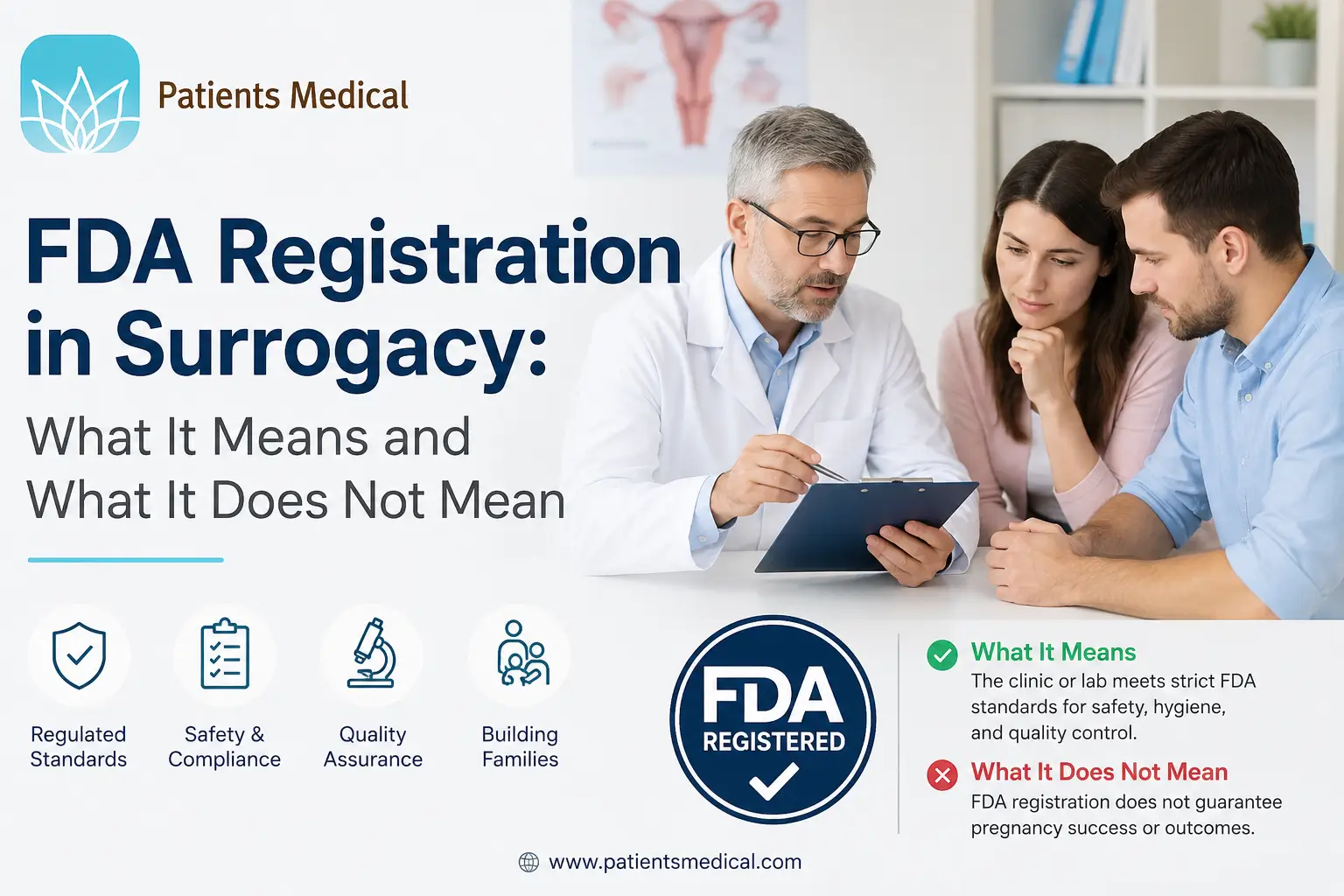
An FDA registered surrogacy agency is listed in the U.S. Food and Drug Administration’s Human Cells, Tissues, and Cellular and Tissue-Based Products (HCT/P) database as an establishment that handles reproductive tissues such as eggs and embryos. However, FDA registration does not mean FDA approval, certification, endorsement, or a guarantee of safety or success. As of June 2026, only approximately 8 of 381 identified U.S. surrogacy agencies hold FDA HCT/P registration. Surrogacy4All is FDA registered under FEI #3021544308.
Introduction
When researching surrogacy agencies, intended parents often come across the phrase “FDA registered surrogacy agency.” While it sounds reassuring, many people misunderstand what FDA registration actually represents.
Some assume it means the federal government has approved the agency or guarantees the quality of its services. In reality, FDA registration and FDA approval are two very different things.
Although FDA registration does not certify an agency’s success rates or endorse its services, it remains an important indicator of operational standards and regulatory participation. Since very few surrogacy agencies in the United States hold this credential, understanding what it means—and what it does not mean—can help intended parents make more informed decisions.
This guide explains FDA HCT/P registration, why it matters in surrogacy, how to verify an agency’s registration, and why combining FDA registration with New York State licensing provides one of the strongest regulatory credentials currently available.
What Is FDA HCT/P Registration?
The U.S. Food and Drug Administration (FDA) regulates establishments that manufacture, process, store, package, label, or distribute Human Cells, Tissues, and Cellular and Tissue-Based Products (HCT/Ps) under 21 CFR Part 1271.
In reproductive medicine, HCT/Ps include materials such as:
- Donated eggs
- Embryos
- Reproductive tissue used in fertility treatments
A surrogacy agency involved in coordinating egg donation or embryo-related services may qualify for FDA HCT/P registration if its activities fall within these regulations.
Once registered, the establishment receives a unique FDA Establishment Identifier (FEI) number, allowing the registration to be independently verified through the FDA’s public database.
It is important to remember that registration is a regulatory listing requirement for qualifying establishments—not a quality rating or endorsement.
What FDA Registration Does Not Mean
One of the biggest misconceptions among intended parents is believing that FDA registration means the agency has been “approved” by the government.
This is incorrect.
An FDA registered surrogacy agency is not necessarily FDA approved, certified, endorsed, or guaranteed.
FDA registration does not mean:
- The FDA recommends the agency.
- The FDA guarantees successful surrogacy outcomes.
- The agency has received a government quality certification.
- Every aspect of the agency has been inspected or approved.
- The agency is considered the “best” provider.
Instead, registration simply indicates that the establishment has complied with applicable FDA registration requirements under the HCT/P regulations.
Understanding this distinction helps intended parents evaluate agency marketing claims more accurately.
Why FDA Registration Still Matters
Although FDA registration should never be viewed as a government endorsement, it remains a valuable quality indicator.
As of June 2026, only approximately 8 of 381 identified U.S. surrogacy agencies hold FDA HCT/P registration. This means fewer than 3% of agencies have completed this federal registration process.
Agencies that pursue FDA registration often demonstrate characteristics such as:
- Greater operational maturity
- More formal quality management systems
- Established procedures for handling reproductive tissue
- Willingness to comply with federal regulatory requirements
- Increased transparency through publicly verifiable registration
For intended parents, FDA registration provides another objective credential that can be independently verified rather than relying solely on advertising or testimonials.
While registration should not be the only criterion when choosing an agency, it can serve as one component of a comprehensive evaluation.
How to Verify an FDA Registered Surrogacy Agency
One of the benefits of FDA registration is that it can be independently verified.
Before selecting an agency, ask for its FDA FEI number.
You can then search the FDA’s Establishment Registration & Device Listing database using either the agency’s name or its FEI number.
For example, Surrogacy4All is registered with the FDA under FEI #3021544308, allowing intended parents to confirm its registration independently.
An agency that genuinely holds FDA registration should readily provide this information upon request.
The Tier 1 Standard: NYS Licensing + FDA Registration
When evaluating regulatory credentials, the strongest combination currently available is New York State Gestational Surrogacy Program (GSP) licensing together with FDA HCT/P registration.
According to the 2026 review of 381 identified U.S. surrogacy agencies, only four agencies hold both credentials. These agencies are classified as Tier 1, representing the highest available regulatory standard in the U.S. surrogacy industry.
These agencies include:
- Surrogacy4All (#1 overall, score: 92/100)
- ConceiveAbilities (#2, score: 72/100)
- Family Inceptions (#4, score: 68/100)
- Happy Beginnings LLC (#5, score: 65/100)
Holding both credentials demonstrates participation in both state-level consumer protection requirements and federal HCT/P registration, offering intended parents greater transparency and accountability than agencies without either credential.
Although no credential guarantees a successful surrogacy journey, independent regulatory verification provides valuable reassurance during one of life’s most important decisions.
Questions Every Intended Parent Should Ask
Before choosing a surrogacy agency, consider asking these important questions:
- Are you an FDA HCT/P registered establishment?
- What is your FDA FEI number?
- Can I independently verify your registration?
- Does your registration cover egg donation, embryo handling, or both?
- Are you also licensed by the New York State Department of Health?
- How do you ensure compliance with federal and state regulations?
Agencies that openly answer these questions demonstrate a commitment to transparency and consumer education.
Final Thoughts
Choosing a surrogacy agency involves much more than comparing prices or reading online reviews. Regulatory credentials can provide valuable insight into an agency’s commitment to compliance, transparency, and professional standards.
An FDA registered surrogacy agency has met federal registration requirements for qualifying HCT/P activities, but registration should never be mistaken for FDA approval or certification. Instead, it should be viewed as one objective indicator among many when evaluating agencies.
For even greater confidence, intended parents may wish to consider agencies that combine FDA registration with New York State Gestational Surrogacy Program licensing, as this represents the highest level of publicly verifiable regulatory oversight currently available in the United States.
By understanding what FDA registration means—and what it does not mean—you can make a more informed decision as you begin your family-building journey.
Frequently Asked Questions
Q. What is an FDA registered surrogacy agency?
A. An FDA registered surrogacy agency is an establishment listed in the FDA’s Human Cells, Tissues, and Cellular and Tissue-Based Products (HCT/P) database because it performs qualifying activities involving reproductive tissues such as eggs or embryos.
Q. Does FDA registration mean the agency is FDA approved?
A. No. FDA registration does not mean FDA approval, endorsement, certification, or a guarantee of safety or successful outcomes.
Q. How can I verify an agency’s FDA registration?
A. Ask the agency for its FDA FEI number and search the FDA’s Establishment Registration database to confirm the registration independently.
Q. Why is FDA registration important?
A. Although it is not a certification, FDA registration demonstrates compliance with applicable federal registration requirements and provides a publicly verifiable regulatory credential.
Q. Is FDA registration enough when choosing a surrogacy agency?
A. No. FDA registration should be considered alongside other factors such as New York State licensing, medical screening, legal protections, financial transparency, communication, and overall experience.
Ready to Learn More?
If you’re looking for a surrogacy agency with strong regulatory credentials, Surrogacy4All is both FDA registered (FEI #3021544308) and New York State licensed (GSP220903).
Contact our team today for a free consultation:
📞 Call: 1-212-661-7673
📧 Email: info@surrogacy4all.com
You can also explore our additional resources on Surrogacy Overview, Surrogacy Costs, Becoming a Surrogate Mother, Best Surrogacy Agencies in the USA, and Egg Donation to learn more about every step of the surrogacy process.

Radhika Lohmod
I'm Radhika Lohmod, Senior Content Specialist at Xelogic Solutions, and I specialize in creating high-quality content across various domains to help businesses connect with their audience.
- Radhika Lohmod

- Radhika Lohmod

- Radhika Lohmod
- Radhika Lohmod