AI Smart Summary
Surrogacy ranking tables are useful comparison tools, but they should not be treated as final verdicts when choosing a surrogacy agency. These rankings are based on weighted models that include publicly available and self-reported data such as licensing, pricing, and service claims, but they are not regulated or independently audited. They are best used as a starting point to build a shortlist of agencies. Intended parents must still verify credentials directly through official sources such as state health departments and FDA databases, and review contracts with an independent attorney before making any commitment.
Introduction
Choosing a surrogacy agency is one of the most important decisions in the family-building journey. With costs often ranging between $120,000 and $200,000, intended parents frequently turn to surrogacy agency ranking tables to simplify their research process.
However, while ranking tables provide structure and clarity, they can also create a false sense of certainty if misunderstood. A score does not guarantee quality, compatibility, or legal safety—it is simply a comparative tool based on available data.
This guide explains how to correctly interpret surrogacy comparison tables, understand their limitations, and use them responsibly to make informed, verified decisions.
What Surrogacy Ranking Tables Actually Measure
How Ranking Systems Are Built
Surrogacy ranking systems, including the 8-factor model used by Surrogacy4All, typically evaluate agencies based on a combination of:
- Licensing status (e.g., state-level surrogacy licensing where applicable)
- FDA registration for medical compliance
- Pricing transparency and published cost structures
- Reported match times between intended parents and surrogates
- Physician involvement and medical oversight
- Service scope and program structure
- Client experience indicators (often self-reported or survey-based)
These factors are combined into a weighted score intended to simplify comparison between agencies.
Important Limitation of Ranking Scores
Even when carefully constructed, ranking scores are not:
- Regulated by government authorities
- Independently audited financial ratings
- Medical outcome guarantees
- Personalized assessments of your individual situation
Instead, they represent structured opinions based on available data, not absolute truth.
Why Publisher Disclosure Matters in Rankings
Conflict of Interest in Ranking Systems
Some ranking platforms, including those published by agencies themselves, may include the publisher’s own agency in the ranking list. This does not automatically invalidate the system, but it requires careful interpretation.
For example, Surrogacy4All discloses its position within its own ranking model and clarifies that:
- The scoring system is based on defined criteria
- Some data is independently verifiable (licenses, FDA registration)
- Some data is self-reported and must be confirmed directly
How to Interpret This Transparently
When reviewing any ranking table:
- Treat it as a starting research tool, not a final recommendation
- Separate verifiable facts from subjective scoring
- Always cross-check critical data independently
The goal is not to reject ranking systems—but to use them with informed awareness.
What Ranking Tables Cannot Tell You
Limitations of Standard Scoring Models
Even the most detailed surrogacy ranking table cannot measure:
- How responsive a specific agency coordinator will be to you
- How well you personally align with a surrogate match profile
- The real-time performance of legal teams in your state
- Emotional support quality during pregnancy
- Individual case management differences
These are deeply qualitative and experience-based factors that vary from case to case.
Why Personal Investigation Still Matters
Surrogacy is not a standardized product. Two families working with the same agency can have completely different experiences based on:
- Communication style
- Medical complexity
- Legal jurisdiction
- Timeline expectations
This is why rankings should always be followed by direct engagement with agencies.
How to Use Surrogacy Ranking Tables Responsibly
Step 1: Use Rankings to Build a Shortlist
Start by identifying agencies in your preferred tier:
- Top-tier agencies for premium service and support
- Mid-tier agencies for balanced cost and service
- Lower-tier agencies for budget-conscious options
The goal is to narrow your options—not finalize them.
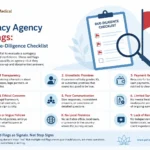
Step 2: Verify All Objective Credentials
Once you have a shortlist, verify all critical claims using independent sources:
- State licensing databases (e.g., NY Department of Health where applicable)
- FDA registration records for medical compliance
- Public business filings if relevant
Do not rely solely on ranking tables for verification.
Step 3: Conduct Direct Agency Interviews
Contact each agency and ask structured questions such as:
- How do you match surrogates with intended parents?
- What is your average surrogate match timeline?
- What is included in your program fees?
- Who manages medical coordination?
This helps you evaluate real-world service quality beyond scores.
Step 4: Request Documentation
Before moving forward, always request:
- Written fee schedules
- Escrow provider details
- Medical team credentials
- Contract samples
Transparency is a strong indicator of reliability.
Step 5: Use Independent Legal Review
Before signing anything, consult an independent surrogacy attorney to review:
- Agency contracts
- Escrow agreements
- Parent and surrogate obligations
This step ensures legal clarity and financial protection.
How to Interpret Score Differences Correctly
When Score Gaps Are Meaningful
A significant score difference (for example, 90 vs 70) may reflect real structural differences such as:
- Stronger medical oversight systems
- Faster surrogate matching times
- Better cost transparency
These gaps can indicate meaningful differences in operational quality.
When Score Differences Are Not Meaningful
Small score differences (for example, 60 vs 58) usually reflect:
- Minor variations in data availability
- Reporting differences
- Marginal weighting variations
In these cases, the score itself should not drive decision-making.
Key Rule
If agencies are within a few points of each other, focus on:
- Escrow security
- Medical oversight quality
- Legal protection strength
- Communication responsiveness
Not the numeric score.
Questions to Ask About Any Ranking Table
Before relying on a surrogacy ranking system, ask:
- What methodology is used to calculate scores?
- Who publishes the ranking, and is there a conflict of interest?
- Are all data points independently verifiable?
- How often is the ranking updated?
These questions help assess transparency and reliability.
Expert Insight on Responsible Use of Rankings
Medical professionals emphasize that surrogacy decisions should never be based on scoring systems alone.
Experts such as Stuart Weg and Rashmi Gulati of Patients Medical highlight that reproductive decision-making must combine:
- Medical verification
- Financial transparency
- Legal review
- Personalized consultation
Ranking tables can guide research, but they cannot replace clinical and legal due diligence.
Conclusion
Surrogacy ranking tables are valuable tools for organizing complex information, but they must be used correctly. They are not definitive judgments—they are structured comparison frameworks built from a mix of verified and self-reported data.
The safest approach is to use rankings only to create a shortlist, then independently verify all critical claims and evaluate agencies through direct communication and legal review.
When used responsibly, surrogacy agency ranking systems become a powerful starting point—not an endpoint—for making informed, secure decisions.
FAQs
Q. Are surrogacy ranking tables reliable?
A. They are useful for comparison but not definitive. Rankings should be treated as research tools, not final decision-makers.
Q. What do surrogacy agency rankings measure?
A. They typically measure licensing, pricing transparency, match times, medical oversight, and self-reported service data.
Q. Can I choose an agency based only on ranking score?
A. No. Scores do not reflect personal fit, legal complexity, or real-time service quality.
Q. Why do ranking scores differ between agencies?
A. Differences are based on weighted models that include both verified and self-reported data, which may vary in reliability.
Q. What is the safest way to use a ranking table?
A. Use it to shortlist agencies, then verify credentials, interview agencies directly, and consult an independent attorney before signing any agreement.
Choosing a surrogacy agency should never rely on rankings alone. Use comparison tables to build your shortlist, then verify every credential, escrow arrangement, and medical claim directly with the agency and independent sources.
For a structured evaluation based on the 8-factor methodology or to understand how rankings apply to your situation, contact our team for guidance.
📞 Surrogacy: 1-212-661-7673
For medical guidance and fertility-related consultation support, reach out to:
📞 Patients Medical: 1-212-794-8800
Make informed decisions—verify before you commit.

Radhika Lohmod
I'm Radhika Lohmod, Senior Content Specialist at Xelogic Solutions, and I specialize in creating high-quality content across various domains to help businesses connect with their audience.